Friday, March 4, 2022

Short Book Reviews: Creating Alien Community


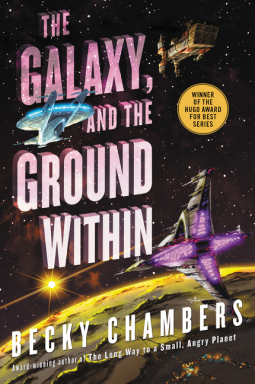
The Galaxy, and the Ground Within,
by Becky Chambers (Harper Voyager)

Set on an uninhabitable planet whose only value is as a stopover for other worlds, this story explores what happens when members of very different species and histories are forced into community when they are temporarily cut off from contact with the larger Galactic Commons. Three of these strangers are guests at the overwhelmingly hospitable Five-Hop One-Stop version of a spacer’s truck stop when a freak accident halts all traffic and communications. At first glance, they have little in common: an exiled artist with an urgent, perhaps redemptive appointment to keep, a cargo runner with a military history at a personal crossroads, and a mysterious individual who cannot leave her space suit but is doing her best to help those on the fringes. Add to this odd grouping, their host and her teenager, furred quadrupeds that reminded me repeatedly of space otters. Most of all, though, this book is about how people who are initially not only diverse but at odds with one another can bridge those differences through understanding and shared experiences to form friendships and, ultimately, community.


Monday, February 28, 2022

Guest Blog: Giving Up on a Novel - Yes or No?

 Today's guest post comes from Janice Hardy's "Fiction University."

How to Tell if You Should You Give Up On Your Novel and Write Something New

By Janice Hardy

Not all novels need to be written. Is yours one of them?

Right after my third novel was published (2011), I hit a bad patch of writing. My muse went on vacation, every sentence I typed was a battle, and writing became a chore I dreaded. Although it felt like giving up, I shifted my writing focus to nonfiction until telling stories became fun again. Eventually it did, but it took years.

I wrote a lot of so-so novels during that time. Every single one was based on an idea I loved, but they needed a lot of revising and overhauling to make them work, and I wasn’t sure if revising them yet again was a good idea or not.

Idea #1 frustrated me for two and a half years of revisions. Idea #2 took another two years of my life that went nowhere. Idea #3 was a NaNo project that actually made writing fun again, but then languished when I wasn't sure what to do with it next. It was outside my regular genre and market, and trying to sell that one felt like I was starting over again as a writer.

I wanted to make those novels work. The stubborn side of me needed to make them work—it became a grudge match. But going back to them risked me falling back into that same bad patch of frustration that made me hate writing.

Is it wise to keep struggling with a novel that might never work, or is it better to work on something new?


This is a tough call for any writer. We put so much effort into a manuscript, and it’s hard to let that go. All that work. All that creative energy. Just gone. It’s easy to understand why we hold on tight and refuse to let go, even if deep down, we know we should. The manuscript is drowning, and it’s dragging us under with it.

If you're facing a similar choice, here are some things to consider:

1. How much work does the manuscript really need?


Sometimes the only way to make a novel work is to trash everything but the idea and start fresh. Which means, if it usually takes you two years to write a novel, it'll likely take you that long to to do a full re-write. Don't con yourself about this (it's SO easy to do)...if all the manuscript needed was a few months of tweaks, you probably would have done that already.

Take some time and look at what needs to happen to make the novel work. Really understand what you're getting yourself into by staying with it. Do you really want to put that much more work into this idea? There's no wrong answer here, This is about you.

For example, for my books, Idea #1 needed a different protagonist, a deleted POV character, and a plot revamp. Half the book would have to be rewritten, and the other half revised to make the new parts work. Idea #2 needed a total rewrite from the plot up. The plot direction was what didn't work. Idea #3 just needed the normal amount of revising. 

(Here’s more on 3 Ways to Tell if a Manuscript Is Worth Going Back to) 

2. What are the odds that working on this manuscript will trigger the same frustrations as before?


Be honest. If you're breaking out in a cold sweat just thinking about it, that's a pretty good indication you should move on to something new. But if there's a glimmer of excitement at finally getting this project to work, maybe it's worth giving it another shot.

How do you feel about the novel? What emotions does it trigger in you? Is it keeping you from writing?

For me, Idea #1 carried a very real risk of plunging me back into darkness. There was just so much baggage associated with it, and even though I loved the idea, and I thought I could rework it in six months, I'd thought that before. Idea #2 didn't have that same risk. I could start over there and be okay. It wasn't the book that made me dread writing, so it didn't have the same emotional triggers. Idea #3 was fun to write, and probably fun to revise.
Friday, February 25, 2022

Short Book Reviews: A Physician-Sorcerer Takes on an Epidemic


The Physicians of Vilnoc
, by Lois McMaster Bujold (Subterranean)

This latest novella featuring temple sorcerer and sometimes healer, Penric, and his chaos demon, Desdemona, is a love letter to epidemiologists. In a time of plague, tracing the course of the outbreak is the key to gaining control. Is it contagious? What is the means of spread? How did it enter the community? Who dies, and who survives—and why? In this tale, Penric is summoned to an army fort town where a mysterious illness is rapidly spreading, threatening the ability of the soldiers there to defend the port capital. Through Desdemona, Penric can manipulate chaos, thereby allowing a patient’s body to heal itself, but the cost can be high and the limitations on what one sorcerer can do, are great. Through Desdemona, he can siphon off chaos from a patient’s body, in essence lowering the entropy and increasing the orderliness of the tissues. But the amount of chaos remains the same, and Desdemona can absorb only so much. The best way to discharge it is through the ultimate increase in entropy, the death of a living creature. This poses a moral dilemma for Penric, for although ridding the place of fleas and rats is not a problem, their tiny lives are not sufficient. He sets up an arrangement with the butcher to slaughter food animals quickly and painlessly, but even that cannot keep up with the increasing accumulation of chaos.

Over her long existence, Desdemona has passed through a series of hosts, not all of them human, and she carries their memories and wisdom. Her relationship with Penric is exceptional because he treats her as a partner and not as a dangerous, rebellious slave to be controlled at every step. As a consequence, or perhaps as a result of the variety of hosts she’s known, Desdemona has slowly acquired the ability to trust and be trusted. She’s still a demon, but she’s one that values her host and his concerns.

Besides his partnership with Desdemona, Penric also has an inquiring mind and keen analytic skills, with the ability to see through the easy, superficial explanations. He knows that knowledge of how the disease is spread and where it came from is crucial to containing it, but he’s being run ragged in trying to save lives. He’s in dire need of help, but in even more desperate need of information.

I loved all the previous “Penric” stories, but this one was particularly resonant, given that we are now entering our third year of the Covid-19 pandemic. The Physicians of Vilnoc is a poignant and compelling reminder of our vulnerability to contagious diseases, and the importance—the necessity—of meticulous epidemiology in combatting them.


Thursday, February 24, 2022

Repost from The Conversation: Ukraine conflict brings cybersecurity risks to US homes, businesses


Ukraine conflict brings cybersecurity risks to US homes, businesses

Regular Americans could find themselves targets of Russian cyberwarfare. Roberto Westbrook via Getty Images
Richard Forno, University of Maryland, Baltimore County

All cybersecurity is local, regardless of the world situation. That means it’s personal, too – in Americans’ homes, computers and online accounts. As violence spreads thousands of miles away from the U.S., my strong recommendation is that all Americans remain vigilant and check on their own cybersecurity.

While organizations reinforce their cybersecurity posture during this period of geopolitical tension, I also suggest people regularly ensure their computer, mobile devices and software are updated, double-check that all passwords are secure and all key accounts are protected by two-factor authentication. Beware that phishing attacks may increase, seeking to trick people into clicking links that grant attackers access to computer systems. These are a few simple steps that can help increase one’s cybersecurity preparedness both now and for the future.

Recent Russian-linked cyberattacks, including against energy pipelines, federal government services, and attacks on local governments, first responders, hospitals and private corporations, show the potential for Russian cyber warriors to put U.S. civilians at risk. All these entities should be more vigilant over the coming days.

In the days before Russia invaded Ukraine, a series of cyberattacks disrupted Ukrainian government and business websites – despite Ukraine’s cyberdefense teams’ being prepared to defend against them.

With many Americans working from home because of the pandemic, the U.S. is more vulnerable than it might have been otherwise: Home networks and computers are often less protected than those at an office – which makes them enticing targets.

Russian cyber capabilities, and threats from Russian President Vladimir Putin, mean that what might look like random technical glitches on personal computers, websites and home networks may not be accidental. They could be precursors to – or actual parts of – a larger cyberattack. Therefore, ongoing vigilance is more crucial than ever.


[Like what you’ve read? Want more? Sign up for The Conversation’s daily newsletter.]The Conversation

Richard Forno, Principal Lecturer, Cybersecurity and Assistant Director, UMBC Cybersecurity Center, University of Maryland, Baltimore County

This article is republished from The Conversation under a Creative Commons license. Read the original article.

Friday, February 18, 2022

Short Book Reviews: Hallucinatory Noir, With Cockroach

Within Without (A Nyquist Mystery), by Jeff Noon (Angry Robot)


This is the third “John Nyquist Mystery” I’ve read and it’s by far the weirdest. Nyquist’s latest case involves the theft of a sentient, essence-of-glamor image that has gone missing from its host. To investigate, Nyquist and his new assistant travel to the city of Delirium, guarded by boundaries that are far more than checkpoints or physical barriers. Their search for the magic practitioner who created and attached the image to begin with leads them into increasingly bizarre cities-within-cities. In Escher, Nyquist discovers his “Inverse,” the character hidden within his psyche, and it turns out to be Gregor Samsa, the narrator of Kafka’s Metamorphosis, who wakens one morning to discover he has turned into a cockroach. So Nyquist must deal not only with Samsa’s personality and voice, but that of the cockroach. As if that weren’t strange enough, his assistant has become infected with a creeping magical substance and, obsessed with taking the image, named Oberon, for his own, disappears. Plot twists abound, building until Nyquist finds himself in an utterly different plane of existence, one in which the images define and distort reality. The book carries forward and intensifies the hallucinatory texture of the previous Nyquist novels.