Wednesday, November 15, 2017
Thursday, November 9, 2017
Squash Harvest. 2017
Every year we grow winter squashes of various sorts for
food. I specify food rather than decoration because the output of a small plot
of land in nutrients and calories from winter squashes is extremely good. They’re
not only delicious (and beautiful) but are low
in sodium and fat, and provide an array of vitamins, minerals, and fiber.
Growing them is fairly easy, although the vines have a tendency to wander and
take over.
| Midsummer 2017 |
| Autumn 2017 |
Like summer squashes, winter squashes hybridize and so it’s
best to either grow only one variety or start them from commercially obtained
seed or seedlings every year. At least, that’s the theory. We often end up with
“mystery squashes.” (“Wait! I don’t
remember planting that – what is it?”)
Our current theories are: (a) these are truly hybrids from last year’s crops;
(b) they are hybrids from the seeds that entered our garden through compost
scraps. The latter used to be more true when we got vegetable trimmings from
the local health food store. My husband tells me we use “cold” composting
(worms) rather than the “hot” method, so seeds will survive.
| Boer White squash |
| Buttercup, one of our favorites |
Mystery squash, perhaps a hybrid of delicata and acorn. We got two and have devoured one. The shell is quite hard, as it often is with hybrids, but the flesh was delicious.The seeds will go to a friend who runs a seed-saver business.
Wednesday, November 8, 2017
Friday, November 3, 2017
Short Book Reviews: How Many Clones in a Murder?
Six Wakes, by Mur Lafferty (Orbit, 2017). A crew on a
generational space ship wakes – or rather, their clones do, a standard
procedure that usually involves downloading stored memories for continuity. The
one remaining crew, the captain, is near-death, there is blood everywhere, and
none of the clones can remember what happened. In an added twist, all of them
are criminals whose paths have crossed in the past and who have reason to hate
each other.
Skillfully handled action and discovery of information lead to one
plot twist after another. I especially liked how my initial assumptions about each
character were turned inside out in a way that gave them depth and humanity,
even the ship’s AI.
Exceptionally well-done science fiction mystery.
Labels:
clones,
murder mysteries,
science fiction,
space fiction
Thursday, November 2, 2017
A Grand Age of Astronomical Discovery
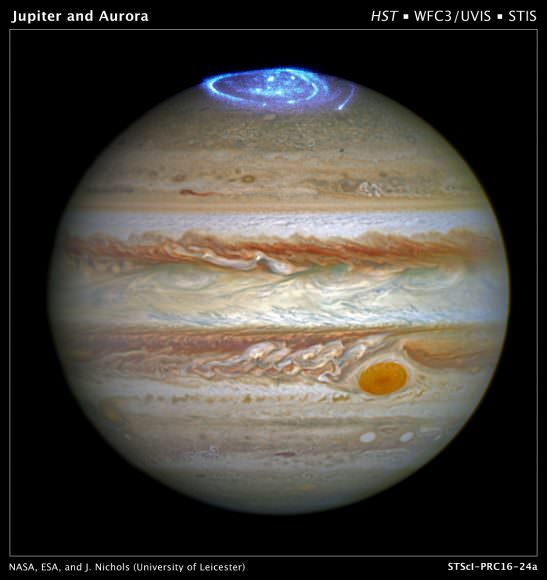
This is an amazing age of astronomical discovery. Not that long ago we could only speculate on the existence of planets around other stars, not to mention exploring those in our own system. We didn't know Jupiter had auroras or any of the many, many amazing discoveries of the last decades. Once we were limited to what our eyes and cameras could detect through the thickness of our terrestrial atmosphere. The Hubble Space Telescope launched our instruments beyond that blurring layer, and other telescopes, both on Earth and in orbit, expanded our view to include other parts of the EM spectrum. We have X-ray and infrared telescopes, and color enhancement by computers. Space probes like the Pioneers, Voyager, Spirit and Opportunity, Cassini-Huygens, Juno, and New Horizons have vastly expanded our understanding of the solar system. Who knows what wonders lie yet to be explored?
Here are a few tidbits in recent news:
Using the NASA/ESA Hubble Space Telescope, astronomers have discovered that the brightest galaxies within galaxy clusters “wobble” relative to the cluster’s centre of mass. This unexpected result is inconsistent with predictions made by the current standard model of dark matter. With further analysis it may provide insights into the nature of dark matter, perhaps even indicating that new physics is at work. Full article here.
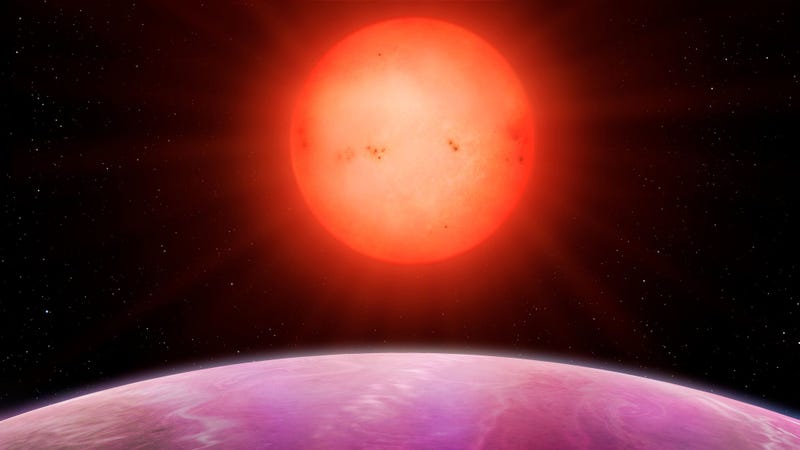
Using an innovative new telescope array, an international team of researchers has discovered a distant gas giant roughly the size of Jupiter around a star half the size of ours. It’s considered the largest planet in proportion to its companion star.
Bayliss and Wheatley spotted the hot Jupiter using the Next-Generation Transit Survey (NGTS) instrument, a wide-field observing facility composed of several telescopes at the European Southern Observatory’s Paranal Observatory in Northern Chile. This state-of-the-art facility is operated by the Universities of Warwick, Leicester, Cambridge, Queen’s University Belfast, Observatoire de Genève, DLR Berlin, and Universidad de Chile. Full article here:
Here are a few tidbits in recent news:
In the past, auroras have been spotted around Jupiter’s poles by NASA’s Chandra X-ray Observatory and by the Hubble Space Telescope. Investigating this phenomena and the mechanisms behind it has also been one of the goals of the Juno mission, which is currently in an ideal position to study Jupiter’s poles. With every orbit the probe makes, it passes from one of Jupiter’s poles to the other – a maneuver known as a perijove. Full article here.
Bayliss and Wheatley spotted the hot Jupiter using the Next-Generation Transit Survey (NGTS) instrument, a wide-field observing facility composed of several telescopes at the European Southern Observatory’s Paranal Observatory in Northern Chile. This state-of-the-art facility is operated by the Universities of Warwick, Leicester, Cambridge, Queen’s University Belfast, Observatoire de Genève, DLR Berlin, and Universidad de Chile. Full article here:
Subscribe to:
Posts (Atom)