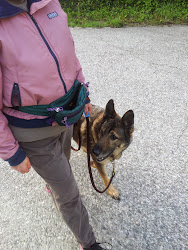
This blog was first posed in 2015. Tajji has since gone over the Rainbow Bridge, but her spirit remains with us. I read an excerpt from this story, "Four Paws To Light My Way" at FogCon last year.
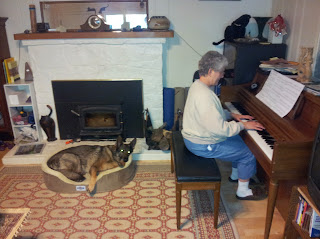
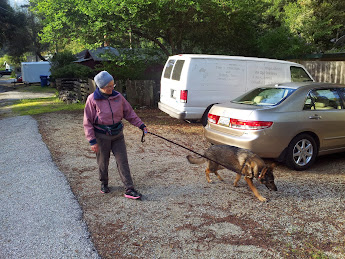
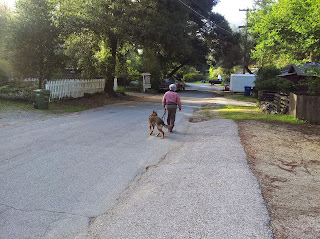
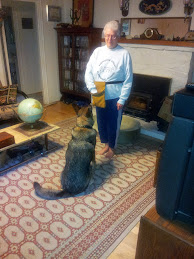
Tajji, our elderly German Shepherd Dog, came to live with us a little over a year ago when she retired from seeing eye guide dog work. She learned new behaviors in the process of “being just a dog.” Her behavior also showed us some of the many things dogs who help the blind must learn. Some of these are responses to commands. Tajji knows “Go Right,” “Go Left,” “Easy (slow down),” and “Back,” for instance. She was also able to enter a mall (a chaotic place for a dog) with her blind person and, never having been in this place before, guide him to an elevator, escalator, or rest room.
Tajji, our elderly German Shepherd Dog, came to live with us a little over a year ago when she retired from seeing eye guide dog work. She learned new behaviors in the process of “being just a dog.” Her behavior also showed us some of the many things dogs who help the blind must learn. Some of these are responses to commands. Tajji knows “Go Right,” “Go Left,” “Easy (slow down),” and “Back,” for instance. She was also able to enter a mall (a chaotic place for a dog) with her blind person and, never having been in this place before, guide him to an elevator, escalator, or rest room.
We also noticed other behaviors from her training. She would
remain lying down in the same place after we had stepped over her, touching
her. Not moving would allow a blind person to remember where she is (and not
trip over her, at least, not twice.) She uses a gentle nose touch as a greeting
(as do most dogs; it’s polite) but also to let us know when she has come to sit
beside us. She asks for attention by touching an arm, sometimes neatly
inserting her nose underneath a hand. In fact, she initiates physical contact
so much we suspect she was not only trained to do so, but bred for the
predisposition.
All of this got my writer’s imagination started thinking
about different ways dogs can be partners with humans. Years ago, I loved
watching movies about Zato-ichi, a blind swordsman in Japan. He had
preternatural hearing, and his ears would twitch when he heard an enemy
approach, undoubtedly a theatrical device to point out to the audience what was
happening internally. Since I was preparing to write a story for Sword and Sorceress 30, the idea came
to me of a blind swordswoman – and putting
Tajji in the story. How would they interact? What could the dog tell my
character and how?