Showing posts with label Roe v Wade. Show all posts

Monday, August 17, 2026

[Reprint} How Dobbs Increased Support for Abortion Rights


Public opinion on abortion has shifted 4 years after Dobbs decision overturned Roe v. Wade
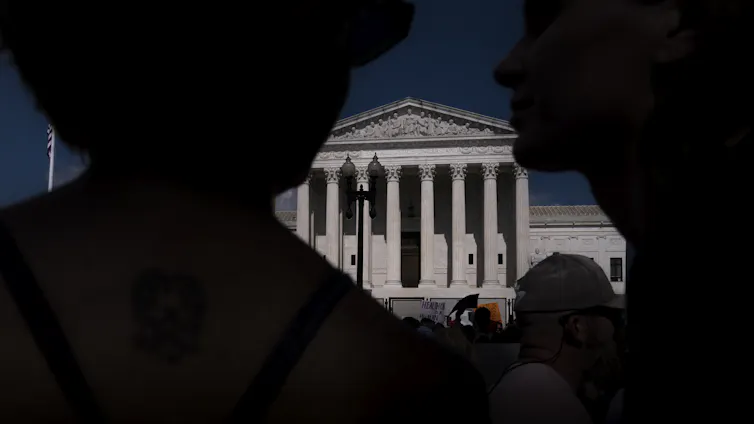
Several people stand in front of a federal building with columns.
People gather in front of the Supreme Court building following the Dobbs v. Jackson Women’s Health Organization ruling on June 24, 2022, in Washington, D.C. Nathan Howard/Getty Images
Laurel Elder, Hartwick College; Mary-Kate Lizotte, Augusta University, and Steven Greene, North Carolina State University

It’s been four years since the Supreme Court’s decision in Dobbs v. Jackson Women’s Health Organization overturned Roe v. Wade, ending the federal constitutional right to abortion.

In the immediate aftermath of the decision, national attention centered on implementation of state bans and a rapidly shifting legal landscape.

But four years later, one of the most impactful developments has been less visible: a significant, sustained and politically consequential shift in public opinion. In the wake of Dobbs, the debate over abortion rights did not simply return to the states. It fundamentally altered how many Americans think about the issue and how they vote.

In our recently published book, “Not Going Back: Public Opinion on Abortion in Post-Dobbs America,” we examined how and why these changes have occurred, and what they mean for U.S. politics. We believe the shift could have real consequences for the November 2026 midterms.

Post-Roe stability

Drawing on several nationally representative surveys conducted before and after Dobbs, we examined how Americans’ abortion attitudes, political priorities and voting behavior have changed in response to the most significant shift in abortion policy in half a century.

For nearly 50 years after Roe, public opinion on abortion was remarkably stable. In 1975, Gallup found support for legal abortion in certain circumstances at 54% and support for a ban in all circumstances at 22%. In 2021 – the year before the Dobbs decision – these figures were virtually the same: 48% and 19%, respectively.

Despite heated political rhetoric, most Americans held nuanced views. They were neither fully anti-abortion nor fully pro-abortion. Instead, they supported legal abortion in some circumstances and not in others.

That underlying stability shaped both policy and politics for decades. Republicans were able to rally a committed core of supporters around opposition to Roe, while the underlying constitutional right to access abortion remained unchanged.

As states moved quickly after the Dobbs decision to enact abortion bans and strict gestational limits, public opinion moved in the opposite direction.

Today, more Americans identify as pro-choice than they did before Dobbs. And, as we document in our book, more Americans are now taking absolutist positions. They support legal access to abortion in all or most cases and oppose government regulation altogether.

How Dobbs shattered the equilibrium

One of the most striking changes in the post-Dobbs era concerns who cares most about abortion. For decades, abortion was a higher priority for Republicans and those identifying as pro-life.

That dynamic has now flipped. In both 2022 and 2024, Democrats and pro-choice Americans were more likely than Republicans to say abortion was a top political issue shaping their vote. In our book, we document how in both 2022 and 2024, pro-choice Democrats were especially motivated to vote and remained highly loyal to Democratic candidates.

At the same time, the considerable minority of Republicans who support legal abortion found themselves politically cross-pressured, meaning they experienced conflicting political influences.

Monday, July 11, 2022

[politics] Strategies for Reclaiming the Right to Choose

The New York Times recently published a piece by, "The Long Road to Reclaim Abortion Rights." Because it's behind a paywall and the information is so important, I've summarized it here.

Abortion rights groups have mounted a multilevel legal and political attack aimed at blocking and reversing abortion bans in courts and at ballot boxes across the country. They have rolled out a wave of lawsuits in nearly a dozen states to hold off bans triggered by the court’s decision, with the promise of more suits to come. They are aiming to prove that provisions in state constitutions establish a right to abortion. They are also working to defeat ballot initiatives that would strip away a constitutional right to abortion and to pass those that would establish one, in states where abortion access is contingent on who controls the governor’s mansion or the state house.

Democratic-aligned groups are campaigning to reverse slim Republican majorities in some state legislatures and to elect abortion rights supporters to positions from county commissioner to state supreme court justices that can have influence over the enforcement of abortion restrictions.

The path ahead is slow and not at all certain. Polls show that Americans overwhelmingly say that the decision to have an abortion should be made by women and their doctors rather than state legislatures. But Republican-controlled state legislatures have passed hundreds of restrictions on abortion over the last decade, and legislative districts are heavily gerrymandered to protect Republican incumbents. Litigation in state courts will be decided by judges who in many cases have been appointed by anti-abortion governors.

Abortion rights groups say their cases offer a viable path forward to establish protections in states. Even in conservative states such as Oklahoma and Mississippi, they see an opportunity to overturn abortion bans and establish a constitutional backstop against further restriction. But in other places, the goal of the litigation is to at least temporarily restore or preserve abortion access, now that the court’s decision stands to make it illegal or effectively so in more than half the states, which include 33.5 million women of childbearing age.

In Louisiana, for example, though the state constitution expressly says there is no right to abortion, the legal challenge has allowed three clinics to continue serving women whose plans to end their pregnancies were thrown into disarray by the court’s decision.

By Friday, the groups had temporarily blocked bans from taking effect in Utah, Kentucky, Louisiana, and Florida; judges have set hearings over the next several weeks to consider permanent injunctions. But they lost bids to hold off bans in Ohio and Texas.