 From
time to time, I take my pile of newly-read books and post reviews. As I
sat down recently to do this, I realized that not a single one of them
was a true stand-alone. They were either the first book at led to others
set in the same world (Kage Baker’s The Garden of Iden, her debut novel and also the first “Company” novel; Garth Nix’s Sabriel, the first book of the “Abhorsen” trilogy); or they were middle books in a series (Bernard Cornwell’s Sharpe’s Prey and Sherwood Smith’s Blood Spirits). The
Baker and the Nix novels differ in that Baker’s story is complete in
itself. No previous knowledge of this world is necessary and the reader
is left in a place of rest. Sabriel, on the other hand, clearly is part of a defined trilogy – one long story arc, with only a partial resolution at the end.
 The Cornwell is clearly part of an ongoing series that follows one primary character through a certain historical time period, with
occasional minor characters, both allies and villains. It is
interesting because Cornwell’s first “Sharpe” book began in the middle
of the hero’s career. After writing a number of novels, he returned to
an earlier time and also “between times,” novels interpolated between
previously-published episodes. Each book centers on a battle or other
specific, time-limited military event in the Napoleonic Wars and
adjacent time periods, and although it is enjoyable to meet old
“friends,” there is little sense of development in plot or tension from
one story to the next. True, the central character matures with
experience, but his personal arc is not the driving force of the novels.
The escalating tension, climax, and outcome of each battle provide the
structure for the plot.
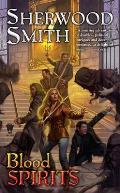 Smith’s Blood Spirits is the middle book of a three-book series (Coronets and Steel; Blood Spirits; Revenant Eve). The “Dobrenica”
books are not a true trilogy, nor are they a sequence of independent
episodes. Enough information is provided so that it is not absolutely
necessary to read the books in order, but it is definitely better to do
so. There is a degree of continuing momentum from one book to the next,
so the books have less of an episodic nature than do the Cornwell
novels.
I’ve been thinking about the whole issue of book “series” because for the last dozen years I have been continuing the “Darkover” series, created by Marion Zimmer Bradley. Especially in the early years, Marion insisted that each book had to stand on its own and that they could be read in any order. I think that’s a laudable goal, and for the most part, the early and middle Darkover books achieved it. Eventually, she began writing books that, while they may not have been part of a single overall story line, were most definitely sequels. Readers may argue with me, but I think that novels such as Thendara House and City of Sorcery fare less well if they are not considered as an extended story line begun with The Shattered Chain. To a lesser extent, Sharra’s Exile (which was itself a rewrite of The Sword of Aldones, a very early Darkover novel) is a sequel to The Heritage of Hastur.
