I’m delighted to
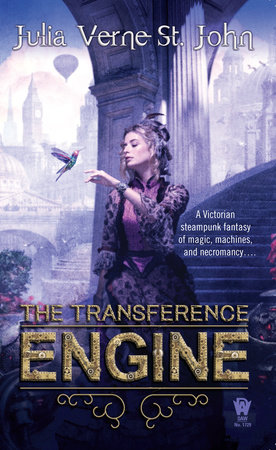
have Julia Verne St. John as my special guest. She’s the author of The Transference Engine, a steampunk novel of magic and machines set in
an alternate 1830s London, just out from DAW Books. Here’s the skinny on the
book:
Madame Magdala has reinvented herself many times, trying to escape Lord Byron’s revenge. She destroyed the Transference Engine Byron hoped to use to transfer his soul into a more perfect body and perpetuate his life eternally. A fanatical cult of necromancers continues Byron’s mission to force Magdala and Byron’s only legitimate child–Ada Lovelace–to rebuild the machine and bring Byron back.
Magdala now bills herself as the bastard daughter of a Gypsy King. She runs a fashionable London coffee salon and reading room while living a flamboyant lifestyle at the edge of polite society. Behind the scenes, she and Ada Byron King, Countess of Lovelace, use the massive library stored at the Bookview Cafe to track political and mercantile activity around the world. They watch to make certain the cult of necromancy surrounding Lord Byron, the poet king who worshipped death, cannot bring him back to life.
On the eve of Queen Victoria’s coronation in June of 1838, rumors of an assassination attempt abound. Both the Bow Street Runners and Magdala’sarmy of guttersnipe spies seek to discover the plot and the plotters. Who is behind the mysterious black hot air balloon that shoots searing light from a hidden cannon, and who or what is the target? And who is kidnapping young girls from all walks of life?
Desperately, Magdala and her allies follow the clues, certain that someone is building a new Transference Engine. But is it to bring back the dead or destroy the living?

Julia Verne St. John: The character of Madame Magdala sprang from The Shadow Conspiracy anthology published by Book View Café. As co-editor I was in on the brainstorming for the shared-world anthology. The moment we decided to insert the Bookview Café as headquarters for the spy network seeking out evidence of a conspiracy to insert life-like automata into places of power with Lord Byron jumping from human body to automaton leading the way, I knew that I had to write the story of the woman in the corner reading the tea leaves. She ended up re-inventing herself as I wrote. She does that
periodically.


