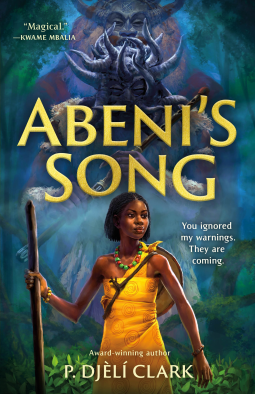
Abeni's Song, by P. Djèlí Clark (Tor)
I requested an ARC of this book from
NetGalley because I loved the author’s previous work. RING SHOUT and THE WAR OF
THE DJINN engaged my imagination with compelling characters and gripping,
freshly inventive stories. Alas, in my reading experience ABENI’S SONG fell far
on all counts. It’s a YA fantasy set in a mythical African village and steeped
in African folklore and customs. The first time I tried to read it, it was so
tedious and slow-paced and its characters so stilted and bland that it
regularly put me to sleep. Then I decided to give it another chance. I made it
halfway through before I realized I was using one excuse after another to not
read any further. All my previous problems were still there, plus more. I gave
up halfway, at a point when I should have been eager to return to the story.
Here’s a roundup of what didn’t work for me:
1.
First and foremost, the
kids lack agency and competence. At twelve, most children—especially those in
traditional societies—already have a wide range of skills. They contribute to
their communities at adult or near-adult levels. Here, they have few
responsibilities, they consistently behave in ways that are disrespectful and
irresponsible, and they are utterly helpless in the face of a threat to their village.
One of the joys of contemporary YA novels for both young and adult readers is
the resourcefulness of the young characters.
2. Abeni and some of her friends are annoying to the point that
I lost all sympathy for them. Abeni, the viewpoint character, seems completely
unaware, for example, of her mother’s fighting skill, something her mother
would have practiced regularly to maintain. She’s a self-centered brat, and no
one except the witch calls her on it.
3. Despite bursts of action, the pacing is excruciatingly slow.
Material is repeated, adding to the already excessive length for a YA novel.
There’s little sense of dramatic shape, and the tension dissipates in the long
gaps between action scenes. I perked up during the attack on the village and
its aftermath, only to have all the dramatic momentum evaporate.
4. The evil characters are two-dimensional, as if they woke up
in the morning and went, “Evil! Evil! Rah-rah-rah!” This is in stark contrast to
the nuanced complexity of the antagonists in Clark’s adult novels.
I am left wondering if this was either
a trunk (early, unsuccessful) novel or an attempt at YA by someone who never
reads it. The prose, annoyingly peppered with exclamation marks and juvenile
(in the worst sense) worldview, is what one might expect if unfamiliar with the
genre. All that said, I liked Clark’s adult novels enough to give future work a
try and hope there will be more of them.

No comments:
Post a Comment