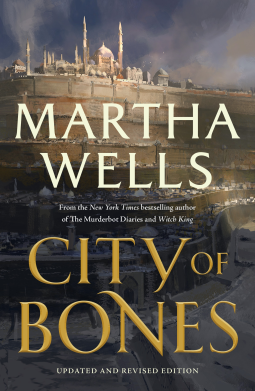
City of Bones (Updated and Revised Edition) by Martha Wells (Tor)
This is an updated and revised, “author’s preferred” version
of a novel by the same name that was published by Tor in 1995. Somehow, I
missed the earlier edition, but this one is a long, intricately detailed story
that is part ecological apocalypse, part mystery, part fantasy, part racial
conflict in a rigidly hierarchical society, and pure adventure.
In a world like Earth, and yet unlike, an ecological
cataclysm has reduced human life to a chain of cities on the edge of the Waste,
an immense desert that is all that remains of once-mighty oceans. Water and
food are scarce, and poverty ensures starvation, except for the nonhuman
semi-marsupial krismen, whom legends say were bred by the Ancients to withstand
desert conditions. The story begins with Khat, a kris, and his human partner,
Sagai, who deal in relics in the bottom tiers of the city Charisat, trying to
stay one step ahead of the dreaded Trade Inspectors, for Sagai has a measure of
protection as a human, but Khat has none. When Khat is approached by Elen, a magic-wielding Warder,
to find relics hidden in a deep-desert artificial structure called a Remnant
and believed to be part of one of the Ancients' arcane engines, he really has
no choice. What begins as a reluctant expedition quickly turns into a struggle
for survival, a deepening mystery, betrayals upon conspiracies, a fanatical
cult bent on transforming what remains of human civilization, and revelations
about the technology and nature of the Ancients.
Although City of Bones was first released three
decades ago, this version represents Wells at her best. Her characters are vividly
drawn, especially Khat, and the gradual way she peels back layers of past and
personality is superb. The world-building, contrasting the rigidly hierarchical
Charisat against the lawlessness of the Waste and the utter chaos of the looming
cataclysm, is intricate, well-thought out, and revealed without ever
overwhelming the reader with a mass of details. There’s enough context and
backstory to fill an entire series.
And then there’s Khat, as human emotionally as he is alien
in physiology. I loved his combination of confidence, physical prowess, inner
wounds, capacity for tenderness, and courage. Most of all, his integrity shines
through the story so that in the end, his choices ring true. Wells created a
character I cared deeply about and then refused to cheapen him with a too-easy
solution.
This is a long book, worthy of being savored, and sure to inspire
readers to return to it for all the nuances we missed the first time.
Highly recommended.

No comments:
Post a Comment